
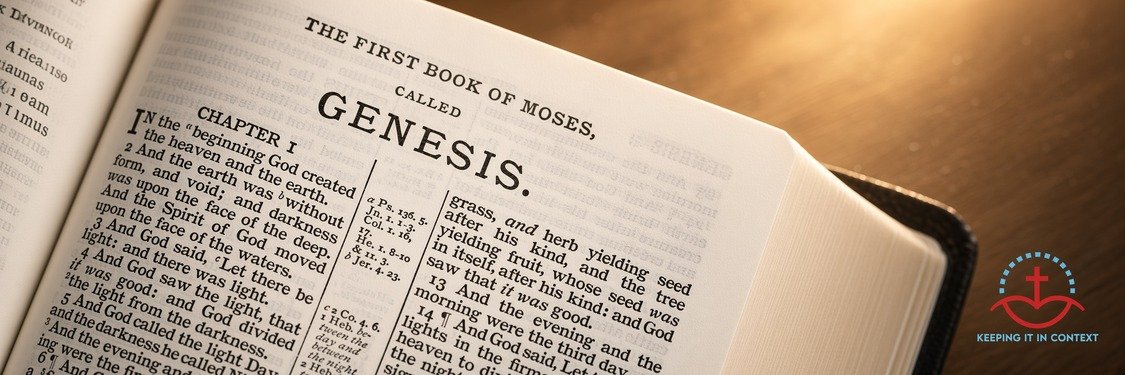
Your Bible May Be Hiding the First Sentence
You already know Genesis 1:1.
“In the beginning God created the heavens and the earth.”
It sounds finished. In this episode of Keeping It In Context, Robert Morris treats it like a claim that still has to be checked.
He doesn’t start with a theory. He opens Logos, puts the ESV on top, and marries it to the Hebrew underneath. Click an English word. Watch the original light up. That’s the whole method: stop assuming the English is doing what the Hebrew is doing.
Where 'the' belongs
He clicks heavens. The Hebrew has the definite article. Same with earth. So far the ESV is honest. Not “heavens in general.” The heavens. The earth.
Then he moves to the first two words.
Where 'the' was added
In English you read in the beginning. In the Hebrew, Robert does not find that the. He finds the preposition. He finds reshit—beginning. The article in your memory is not sitting there in the text.
“The ‘the’ has been added by the ESV translator.”
That is the hinge. Not a mood. A mismatch.
Why one word changes the sentence?
If beginning is not definite, verse 1 cannot do the job we assigned it: a closed sentence with created as the main verb and a period at the end of the thought.
“If the ‘the’ is not there… then you cannot translate it ‘in the beginning.’ Because that would make this verb here—created—like the main verb.”
Traditional English makes verse 1 feel complete. Heavens and earth arrive. Verse 2 then sounds like a later scene, as if God starts working on something that already showed up.
Robert doesn’t think the Hebrew is built that way. So he looks for a rendering that doesn’t force a period where the grammar hasn’t earned one.
The reading that keeps the sentence open
The Jewish Publication Society Tanakh has:
“When God began to create…”
Not a slogan. An opening clause. When God began to create… the earth being unformed and void… God said, “Let there be light.”
On that reading, the first act you actually watch is not a title card. It is speech.
“The first creative act of God is, ‘God said, “Let there be light.”’”
He ties that to 2 Corinthians 4:6—the God who said, “Let light shine out of darkness.” Genesis becomes a story about what God said, not only a sentence we hang on a wall.
He is careful here. Different English should not steal creation from God. It should stop flattening the first line.
Then why do our Bibles still sound the same?
Because Genesis 1:1 is a sales test as much as a text.
“When people go buy a Bible… they want to know how this new translation translates Genesis 1:1. And if they see anything else other than ‘In the beginning, God created the heavens and the earth,’ they probably won’t buy the Bible.”
Familiar wording survives because it is loved—and because it is safe. Robert still thinks the Hebrew should win.
The invitation
The conclusion is not “get a new favorite verse.” It is a habit: open the English, check what was added, ask what the grammar is doing, then read the next verse.
Watch the episode
Robert walks through the Hebrew, compares the ESV and the Tanakh, and then invites you into deeper study—not as a hobby for experts, but as ordinary faithfulness.
Watch the full episode on YouTube:
https://youtu.be/1W9WBa5QqdA
Keeping It In Context begins with weekly episodes on Sunday, August 30 at 7PM CT.
Website: https://keepingitincontext.com
YouTube: https://YouTube.com/@keepingitincontext
Instagram: https://instagram.com/keepingitincontext
X: https://x.com/keepcontext
You know the first sentence.
This time, see what was added to it.