
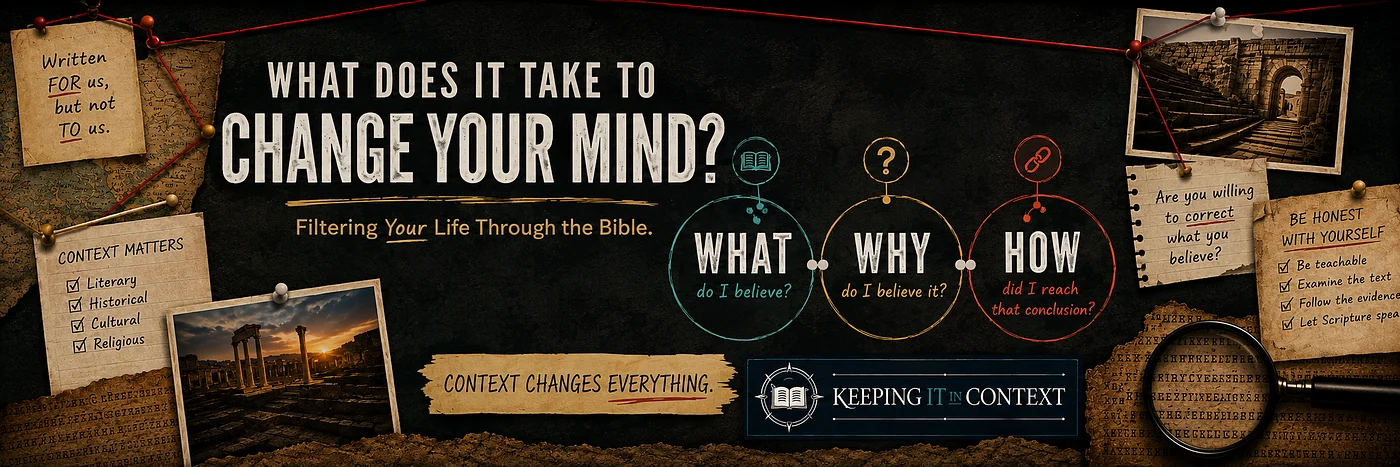
What Does It Take to Change Your Mind About the Bible?
Most of us would probably say we are willing to change our minds when we are shown that we are wrong.
But are we?
That question is much harder when the belief being challenged is something we have believed for years—especially when it involves the Bible.
Maybe it is something your parents taught you.
Maybe you heard it preached every Sunday growing up.
Maybe everyone in your church believes it.
Maybe you have repeated it so many times that you cannot remember why you believe it anymore.
And then one day, you encounter something in Scripture that forces you to ask a difficult question:
What if I have been reading this wrong?
That question gets to the heart of the first episode of Keeping It in Context.
Eight Years in the Making
Keeping It in Context began as an idea on September 25, 2018.
The plan was simple.
Start a show that would help people understand the Bible more carefully by paying attention to the world, language, history, culture, and literary context that produced it.
The road from the idea to the first live episode, however, was anything but simple.
Life happened.
There was loss. Family changes. Health concerns. Work responsibilities. Children entering new stages of life. Grandchildren. Major surgery. And plenty of other circumstances that repeatedly pushed the show further down the road.
Yet the idea never disappeared.
Eight years later, Keeping It in Context is finally here.
And before getting very far into biblical interpretation, I wanted the first show to answer an obvious question:
What Does “Keeping It in Context” Actually Mean?
The word “it” matters.
The “it” in Keeping It in Context is the Bible.
That distinction is important because Christianity can easily become centered on everything except the biblical text.
- Personal experiences can become the center.
- Politics can become the center.
- Psychology can become the center.
- Entertainment can become the center.
Even our favorite pastors, teachers, traditions, and theological systems can become the lens through which we force Scripture to speak.
Keeping It in Context starts somewhere else.
We start with the biblical text.
Then we ask what that text would have communicated within its own world.
That means paying attention to things like:
-
Literary context
-
Historical context
-
Cultural context
-
Religious context
-
The ancient world in which Scripture was produced
The Bible was written for us, but it was not originally written to us.
That single realization can dramatically change the way we read Scripture.
But Context Can Be Uncomfortable
Learning context sounds exciting until context challenges something we already believe.
Then biblical interpretation becomes personal.
It is easy to study the Bible when the text confirms what we already think.
The real test comes when careful study forces us to reconsider a conclusion.
That is why one of the major questions in the first episode is:
What does it actually take to change your mind?
There is a difference between saying:
“I believe the Bible.”
and saying:
“I am willing to allow the Bible, properly understood, to correct what I believe.”
Those are not always the same thing.
Sometimes studying Scripture will strengthen something you already believe.
Sometimes it will add something you had never considered.
And sometimes it will force you to abandon an interpretation that you may have held for decades.
That requires intellectual honesty.
WHAT Do You Believe?
One of the frameworks introduced in the episode is surprisingly simple:
WHAT. WHY. HOW.
Start with WHAT.
What exactly do you believe?
Not what your denomination believes.
Not what your pastor believes.
Not what your favorite YouTube teacher believes.
What do you believe the biblical text is saying?
Sometimes we discover that we have never actually defined our position clearly enough to examine it.
WHY Do You Believe It?
Then comes the more uncomfortable question:
Why?
Why do you believe it?
Did you read it in Scripture?
Did someone tell you?
Did you hear it repeatedly growing up?
Did you inherit the interpretation from your church tradition?
Did you hear someone say, “God showed me…”?
None of those questions automatically prove that a belief is wrong.
But they help us distinguish between having a belief and having a good reason for that belief.
HOW Did You Reach That Conclusion?
Then comes what may be the most important question:
How?
How did you connect the biblical evidence together to reach your conclusion?
This is where interpretation becomes more than finding an isolated verse.
The Bible is a connected collection of texts.
Words connect to sentences.
Sentences connect to paragraphs.
Paragraphs connect to books.
Books connect to larger biblical themes.
Biblical writers reuse earlier Scripture, assume knowledge of their cultural world, employ literary patterns, and communicate ideas that their original audiences were expected to recognize.
So when we interpret Scripture, we are not simply asking:
“Can I find a verse that supports this?”
We are asking:
“Does the biblical evidence actually connect in a way that supports this conclusion?”
That is a very different question.
Genesis 1:1 Provides a Perfect Starting Point
During the first episode, we put this approach to the test with something almost every Christian recognizes immediately:
Genesis 1:1.
“In the beginning…”
It may be one of the most familiar sentences in the entire Bible.
And familiarity can create an interesting problem.
The more familiar a passage becomes, the easier it is to assume that we already understand it.
Sometimes we stop reading what is actually there because we already know what we think it means.
Genesis provides a great example of why context, language, connections, and careful interpretation matter.
And in the episode, we begin exploring what happens when we allow those questions to challenge our assumptions.
This Is Not a “Give Me Homework” Show
Keeping It in Context is not designed to turn every viewer into a professional biblical scholar.
And I am not going to end every episode by handing you three books, six journal articles, four Greek words, and fifty pages of homework.
The goal is much simpler.
I want to introduce you to deeper biblical study.
I want you to encounter ideas, tools, resources, and questions that make you curious enough to investigate Scripture for yourself.
Sometimes one episode may convince you to add something to what you believe.
Sometimes it may convince you to correct something.
Sometimes you may disagree completely.
That is okay.
The point is not that you automatically agree with me.
The point is that we become better at asking:
What does the Bible actually say, and how do we know?
So…Are You Willing to Change Your Mind?
That may ultimately be one of the most important questions we can ask ourselves when studying Scripture.
Not:
“Can I defend what I already believe?”
But:
“If the evidence points somewhere else, am I willing to follow it?”
Because keeping the Bible in context is not merely about accumulating more information.
It is about allowing a better understanding of Scripture to reshape the way we think.
And that is why our mission at Keeping It in Context is simple:
Filtering your life through the Bible.
Watch the episode
If you want to hear the full conversation—including the examples, video clips, Genesis 1:1 discussion, and the WHAT, WHY, HOW framework—watch the complete first episode of Keeping It in Context below.
▶ Watch the full episode:
https://www.youtube.com/live/TaEWT1Etzl8
And while you watch, ask yourself one question:
What would it take for me to change my mind?
Keeping It In Context airs weekly on Sundays at 7PM CT.
Website: https://keepingitincontext.com
YouTube: https://YouTube.com/@keepingitincontext
Instagram: https://instagram.com/keepingitincontext
X: https://x.com/keepcontext